

It is still dark at Gandhi Ghat in Patna, and the river smells of marigold, incense and wet bamboo. A line of women in red and yellow saris comes down the slope barefoot, each with a daura basket on her head, while a loudspeaker behind them plays Sharda Sinha for the thousandth time. Nobody is in a hurry and nobody is talking much. This is Chhath Puja, the festival for which Bihar stops for four days every November, and this guide is for anyone who wants to witness it properly and respectfully.
Chhath is a working religious event, not a show for tourists, so please read the “what not to do” section twice before you go.
Why Chhath Puja Is Unlike Any Other Festival in India
Chhath Puja is the worship of Surya, the sun, and of Chhathi Maiya, a mother goddess identified with Usha, the Vedic dawn, and with Shashthi, the protector of children. It falls six days after Diwali and is observed across Bihar, Jharkhand, eastern Uttar Pradesh and the Terai of Nepal. Bihar claims it as its own, and honestly the claim holds.
Three things make it unusual. There is no priest: the vrati, the person keeping the fast, does everything, and the family carries the rest. Almost nothing used is synthetic either: bamboo soop winnows and daura baskets, brass and earthen vessels, whole fruit with the skin on, clay lamps. It is often called the most eco-friendly big festival in India, fairly, as long as the plastic stays out. And the fast is serious, roughly 36 hours without food or water.
The roots are old. The Rigveda has hymns to Surya and Usha, and tradition links the vrat to Draupadi in the Mahabharata and to Karna, the sun’s son and king of Anga, today’s Bhagalpur. Treat these as the festival’s own account rather than proven history. One thing outsiders get wrong: men keep the vrat too. Plenty of men in dhotis stand in the water with a soop, and the number grows every year.
Chhath Puja 2026 Dates with Patna Sunrise and Sunset
I checked the dates against Drik Panchang for Patna. Shashthi tithi runs from late on the night of 14 November to about 2 am on 16 November, which puts the evening arghya on Sunday the 15th and the morning arghya on Monday the 16th.
| Day | Date (2026) | Ritual | Patna sunrise | Patna sunset |
|---|---|---|---|---|
| Day 1 | Friday, 13 November | Nahay Khay | 6:05 am | 5:02 pm |
| Day 2 | Saturday, 14 November | Kharna (Lohanda) | 6:06 am | 5:02 pm |
| Day 3 | Sunday, 15 November | Sandhya Arghya, evening offering | 6:07 am | 5:01 pm |
| Day 4 | Monday, 16 November | Usha Arghya, morning offering, then parana | 6:07 am | 5:01 pm |
Vratis are in the water a good 45 minutes before sunset, so be at the ghat by 3:30 pm on the 15th. For the morning arghya they stand in the river in the dark from around 5 am and offer the moment the sun shows, so be in position by 5:15 am on the 16th.
Day One: Nahay Khay
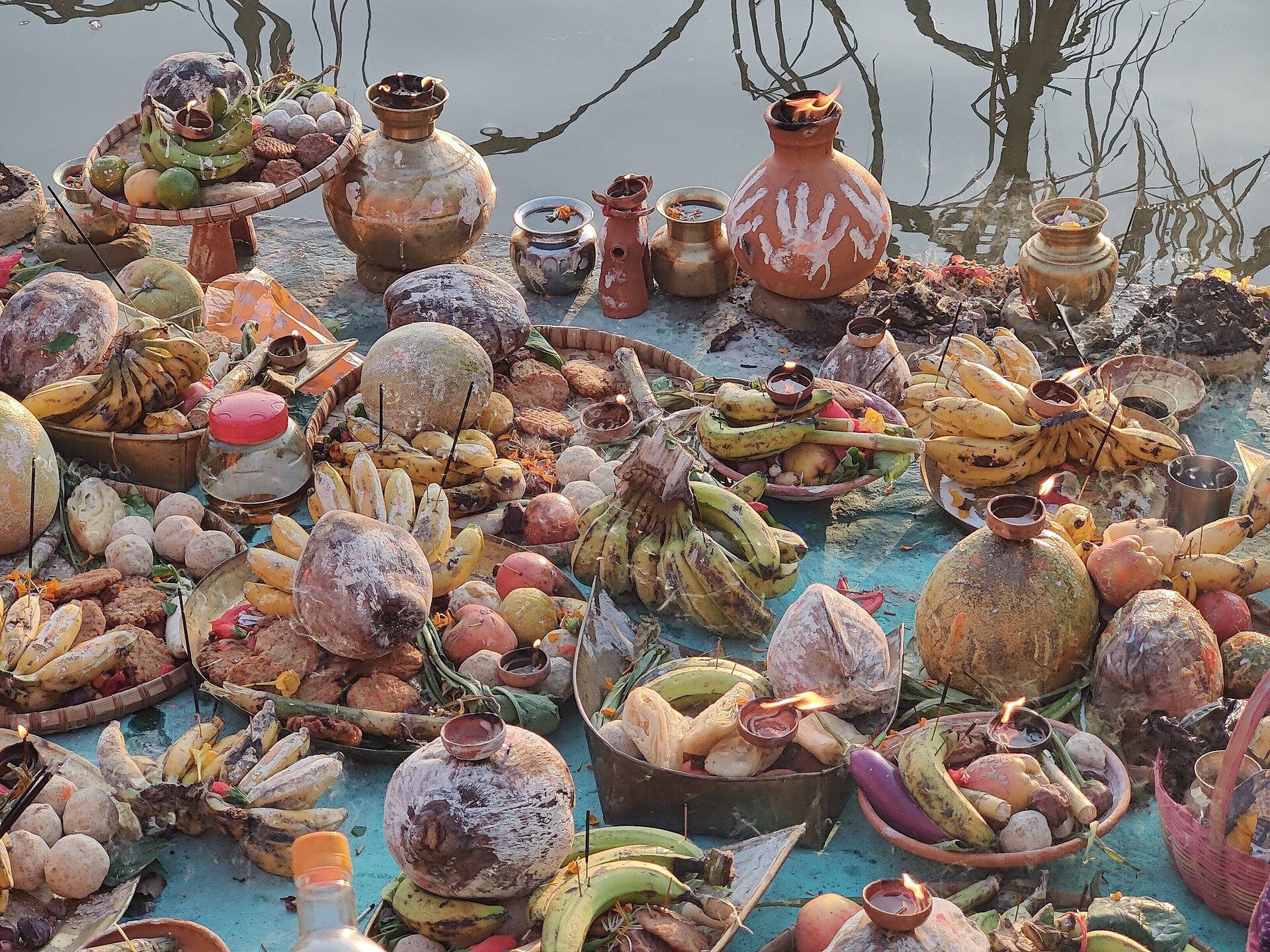
The vrati bathes in the river or a pond and brings home river water to cook with. The house gets scrubbed and the kitchen is reserved for Chhath food only. The one meal of the day is famously plain: rice, chana dal and lauki, cooked on a clay stove with sendha namak instead of ordinary salt.
There is not much to see on day one, but it is the best day to walk the ghats, while the puja samitis, the local committees, finish the barricades and families claim their patch of riverbank. Talk to people. This is the day they have time.
Day Two: Kharna, and the 36 Hours Begin
Kharna is a day-long fast broken after sunset with one specific meal: rasiaw, rice kheer sweetened with jaggery. The vrati eats it in near silence, and the prasad is then shared with everyone who comes to the house. From that moment the nirjala fast begins. No water, no food, until the sun rises on day four.
Day Three: Sandhya Arghya, the Evening Offering
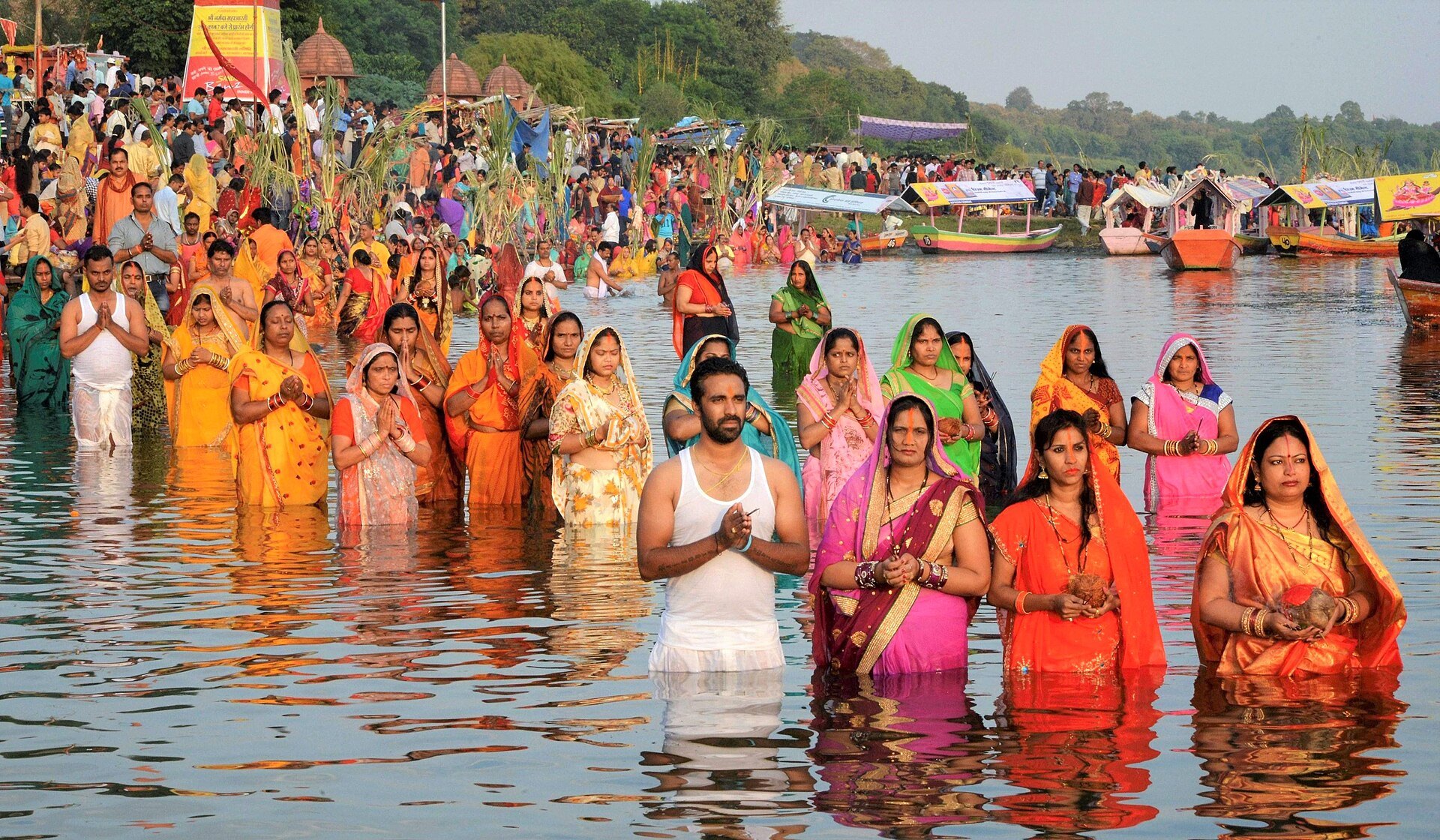
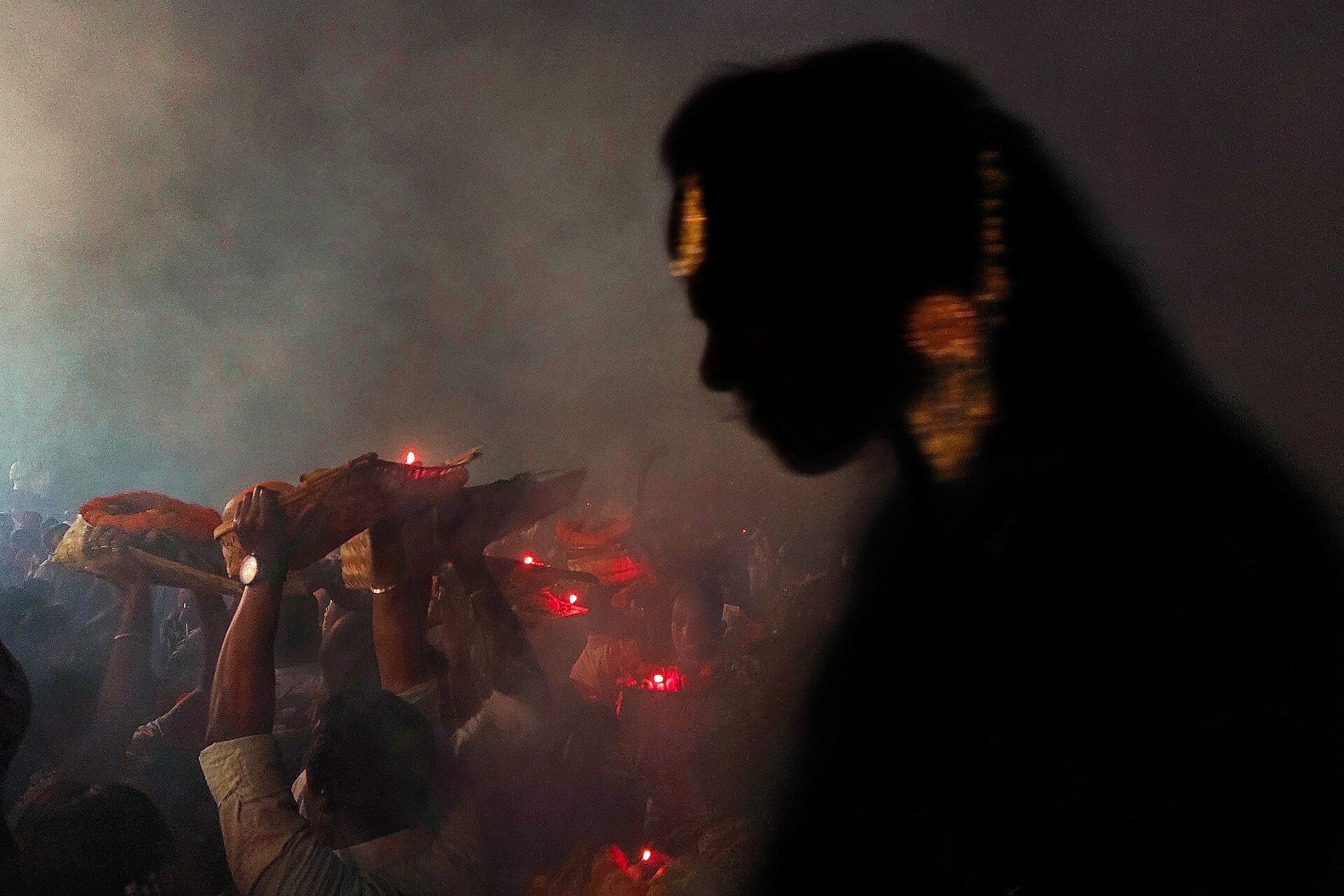
This is the day everyone pictures when they say Chhath Puja. From early afternoon the whole city walks to the water. Women carry the daura on their heads, men carry the heavier baskets and the sugarcane, children carry the diyas. Many vratis walk barefoot the entire way, and some perform dandavat, lying flat on the road every few steps.
At the ghat, the soop are filled with thekua, whole fruit, coconut, sugarcane and a lit diya. Around 4 pm the vrati wades in, waist deep, facing west. As the sun drops, the family hands over one soop at a time; the vrati raises it to the setting sun, pours milk and Ganga water over it from a lota, and hands it back.
The only music is Chhath geet, most of it Sharda Sinha, especially “Kelwa Ke Paat Par” and “Ho Deenanath.” The Bihar Kokila passed away in November 2024, and the ghats have not stopped playing her.
The Kosi at Night
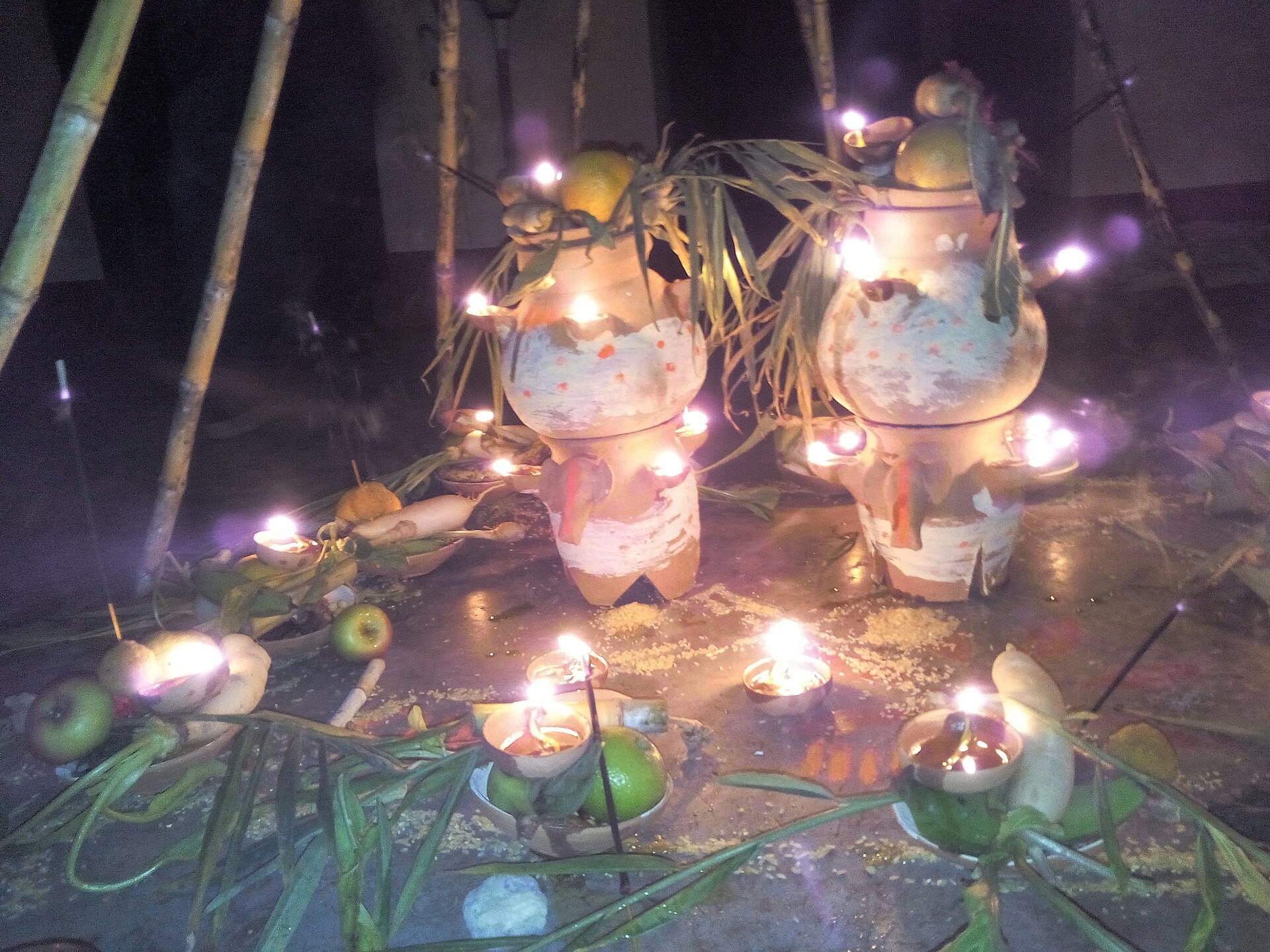
Back home, families whose mannat, their wish, was granted in the past year perform kosi bharna: five or more sugarcane stalks tied into a canopy in the courtyard, a clay elephant under it carrying an earthen pot of thekua and fruit, and a ring of 12 or 24 diyas lit around it. The family sits up all night with it, then carries the canopy to the ghat before dawn.
Walk the lanes of Patna City at 11 pm on the 15th and you will see courtyards glowing under sugarcane arches.
Day Four: Usha Arghya, the Morning Offering
The walk back starts around 4 am in the dark. By 5 am the vratis are in the river again, facing east this time, standing in cold November water for an hour or more. The crowd on the bank is quieter than the evening one and, to my mind, far more moving. When the first rim of the sun appears, the arghya is offered the same way, soop by soop. Then the vrati drinks a little water from a family member’s hands, and the 36 hours are over. That is the parana.
Prasad is handed out right there to anyone who asks. Thekua will be pressed on you by strangers; take it with both hands and eat it. Within an hour the ghats are empty and the whole of Bihar sleeps until lunch.
Thekua, the Soop and the Daura
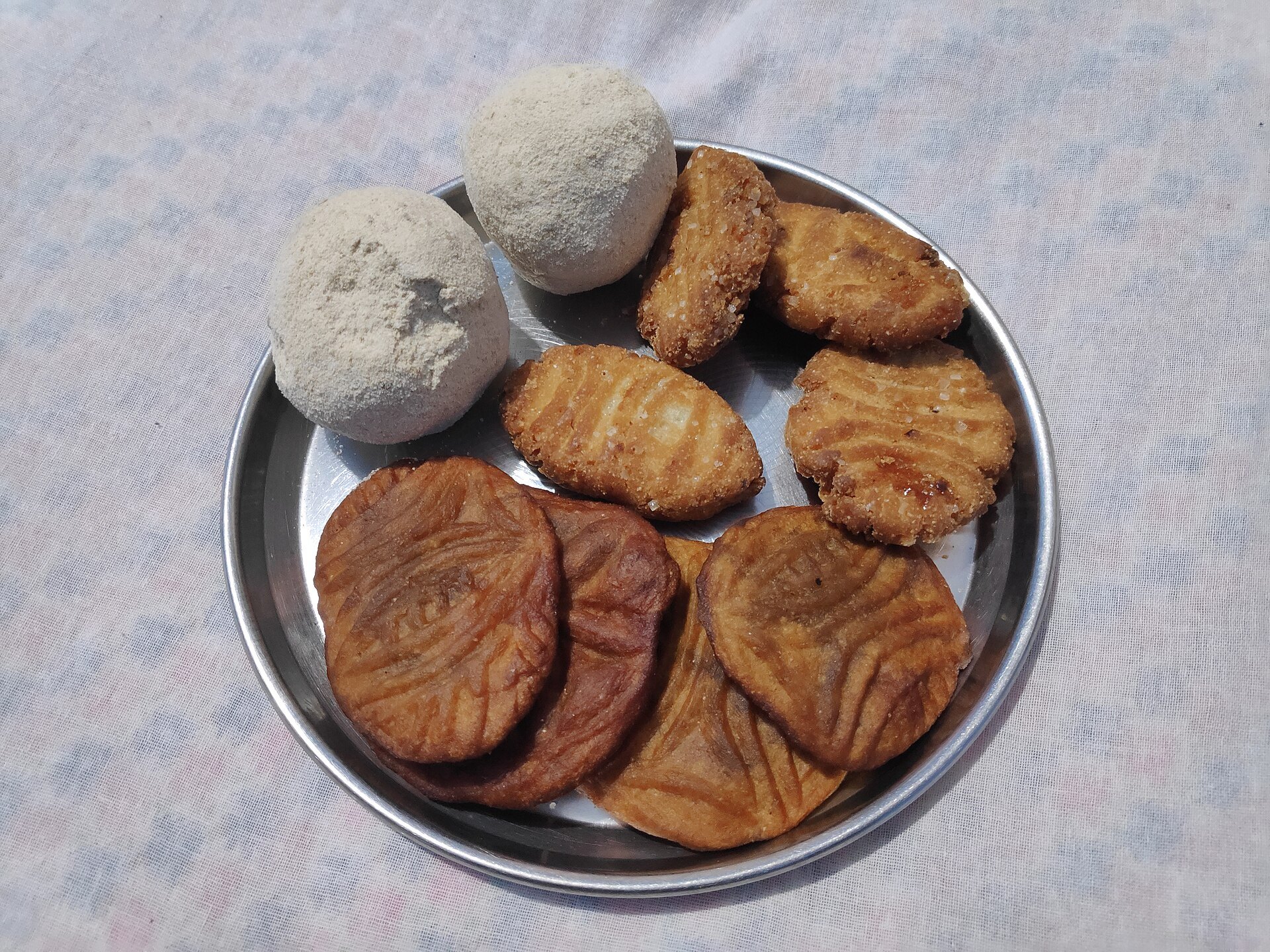
Thekua is the prasad of Chhath Puja and the one thing you must eat. Whole wheat flour, jaggery, ghee and fennel are kneaded, pressed into a carved wooden mould and deep fried until dark brown and hard. Kasar laddu, rice flour and jaggery, goes in the soop beside it. I wrote more about this kitchen in my guide to Bhojpuri cuisine.
The soop is the flat bamboo winnowing tray that holds the offering; the daura is the deep basket it travels in. Both are bought new every year, mostly from Dom basket-weaving families. Expect roughly Rs 80 to 150 per soop and Rs 150 to 300 per daura in Patna’s markets.
Patna’s Ganga Ghats
Patna is the capital of Chhath Puja. The district administration set up 109 ghats last year from Danapur in the west to Patna City in the east. Every ghat is run by a samiti with barricading, lights, changing enclosures, a medical post and a magistrate, and the police close the approach roads from the afternoon.
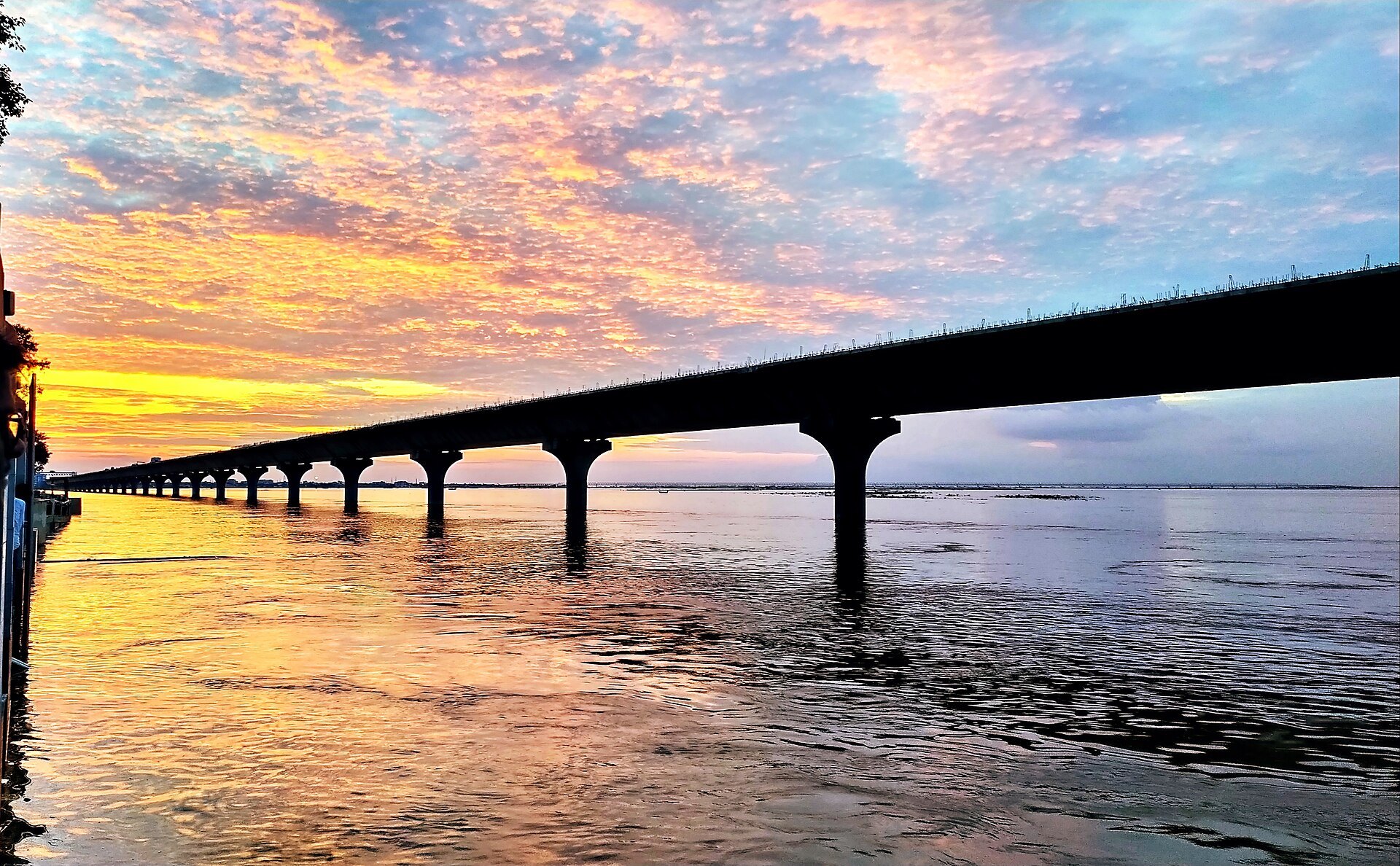
Gandhi Ghat, on the NIT campus, is the classic one, with long steps and the view of the Digha-Sonpur bridge upstream. Collectorate Ghat and Mahendru Ghat are the busiest in the central stretch. The new JP Ganga Path, the riverside road everybody calls Marine Drive, has opened up kilometres of bank, and the ghats along it are the roomiest in the city now.
Two honest warnings. The administration declares a list of unsafe ghats every year because of erosion and deep water; in 2025 it was 13 of them, including Adalat, Gulabi, TN Banerjee and Mishri ghats, so check the Patna district notice in the first week of November. And remember 2012, when a stampede at Adalat Ghat killed 18 people. Move with the crowd, never against it.
Chhath Beyond Patna: Deo, Gaya, Munger and Mithila
Deo Surya Mandir, Aurangabad district
If Patna is the biggest Chhath Puja, Deo is the holiest. The Surya temple at Deo, about 150 km southwest of Patna and 10 km from Aurangabad town, is where the Chhath mela gathers at the sun god’s own house. It has a shikhara around 100 feet high, three images of Surya inside for the rising, midday and setting sun, and an entrance that faces west; the local story is that the invader Kala Pahar tried to break it and the temple turned around overnight.
Vratis offer arghya at the Surya Kund tank beside the temple. Expect 5 to 7 lakh people over the four days, a tent city and no hotel worth the name, so treat Deo as a day trip from Gaya or Aurangabad with a hired car.
Gaya
Gaya’s Chhath happens on the Falgu river and, more atmospherically, at the Surya Kund tank beside the Vishnupad temple, where an old sun temple stands on the bank. Gaya is 100 km from Patna, has its own airport, and combines with Bodhgaya, 13 km away.
Munger
Munger’s claim is that Sita herself kept the vrat here during the exile. The Sitacharan temple sits on a boulder in the Ganga at Kashtaharni Ghat. It is about 180 km east of Patna, four hours by road, and sees almost no outside visitors.
Darbhanga and Madhubani
Mithila does Chhath Puja on ponds rather than the river. Darbhanga’s big tanks, Harahi, Dighi and Gangasagar, are ringed with thousands of diyas on the evening of the 15th, and the songs are in Maithili rather than Bhojpuri.
Where Chhath Puja Is Big Outside Bihar
The Bihari diaspora has carried Chhath Puja everywhere it went. Delhi is the largest: the government counted around 1,500 ghats in 2025, with 23 natural ones on the Yamuna between Palla and Kalindi Kunj and over a thousand artificial ponds, in colony parks in Mayur Vihar, Dwarka and Burari. Mumbai gathers at Juhu beach, where lakhs stand in the Arabian Sea at sunset. Kolkata, barely recovered from Durga Puja, uses the Hooghly ghats at Babughat and Baja Kadamtala; Rabindra Sarobar has been off limits since a 2017 tribunal order.
Across the border, the Nepali Terai keeps Chhath on the same days, and Janakpur’s ponds are a lovely place to see it if you are already there for the autumn trekking season. Further off, the old indentured-labour diaspora in Mauritius, Trinidad, Fiji and Suriname keeps the vrat too, as I noted in my piece on Diwali around the world.
What a Visitor Must Not Do at a Chhath Ghat
Chhath Puja is unusually welcoming to outsiders, which is precisely why you should be careful with it.
- Shoes come off before the puja area. Leave footwear behind the bamboo line or carry it in a bag.
- Never touch a soop, a daura or anything laid out on the ground. The offering is considered spoiled by contact.
- No flash in a vrati’s face, and no camera held over the offerings. Shoot wide, from behind or the side, and ask first.
- Do not walk, wade or paddle in front of a vrati facing the sun. You are standing between them and the sun. Cross behind.
- No alcohol, meat or cigarettes near the ghat. Bihar is a dry state, which solves half of this for you.
- Dress modestly: full-length trousers or a kurta, shoulders covered.
- Accept prasad with both hands. Refusing it is more offensive than any clothing mistake.
Getting There, Staying, and Surviving the Chhath Rush
Chhath week is, without exaggeration, the worst week of the year to move around Bihar. Indian Railways ran more than 6,000 festival specials for the Diwali and Chhath rush last year, and still the waiting lists on the specials into Patna, Darbhanga and Muzaffarpur crossed 150. Book exactly 60 days ahead, the moment IRCTC opens the window, or accept that you are flying.
Flights into Patna’s Jay Prakash Narayan Airport are plentiful but priced like a hostage situation that week; one-way fares from Delhi routinely cross Rs 10,000 in that week. The airport is 6 km from Patna Junction, Rs 300 to 600 by cab. Arrive on 12 or 13 November and leave on 18 or 19 November, because the return rush on the 16th and 17th is worse than the arrival.
In Patna, stay near Gandhi Maidan or Fraser Road, because no cab will get within 2 km of the river on the arghya days. Rough bands: Rs 1,200 to 2,500 for the basic hotels around Patna Junction, Rs 3,000 to 5,500 for mid-range places like Ginger, Rs 6,000 to 9,000 for Lemon Tree Premier near Gandhi Maidan, and Rs 10,000 and up for the Maurya. They fill by mid-October. Bihar Tourism lists the state-run Kautilya Vihar as a fallback.
Shops shut by early afternoon on the 15th, most restaurants close for the arghya, and on the morning of the 16th the city is asleep. Carry cash, because the ATMs near the ghats run dry.
Chhath Without the Crowd
If a lakh people on one ghat puts you off, do not go to Patna at all. Go to Mithila. Darbhanga is about 120 km northeast of Patna, three hours by road or train, and its Chhath Puja happens on neighbourhood ponds where a couple of hundred families share the water. Better still, hire a car from Darbhanga, drive 40 minutes towards Madhubani, pick any village with a pokhar and sit on the bank. You will be given tea and an explanation of every step whether you ask or not.
Deo is the other option, and Munger is the sleeper pick. For the rest of the state afterwards, my five places to see in Bihar and the Mahabodhi temple guide cover it, and the Navratri and Dussehra post explains the festival calendar that leads up to Chhath.
When the Baskets Come Up Out of the Water
There is a moment on the morning of the 16th, just after the sun clears the far bank, when a thousand soop are lifted out of the river at once and the water runs off the bamboo in the first light. It lasts a few seconds, and nobody photographs it well. I think that is the right way to see Chhath Puja: hands full, shoes off, camera down, standing behind someone who has not eaten for a day and a half and is, at that second, perfectly happy.