

Ganesh Chaturthi is not celebrated the same way twice. Travel 200 km in any direction across western and southern India and the festival changes shape completely: ten days of street-level chaos in one city, a quiet family ritual under a canopy of fruit in another, a single day of temple worship somewhere else. If you are planning to travel for it, knowing where the festival is loudest and where it is most intimate matters more than knowing the date.
This guide ranks the places by how big the celebration actually gets, starting with the cities where it takes over daily life and working down to the states where it stays inside the home. Ganesh Chaturthi 2026 begins on 14 September, and the ten-day festival closes with Anant Chaturdashi visarjan on 25 September.
One thing worth knowing before you book anything: the scale you see in Mumbai and Pune is barely 130 years old. Ganesh Chaturthi was a household festival for centuries until Lokmanya Bal Gangadhar Tilak turned it into a public event in 1893, deliberately, as a way for people to gather in large numbers under British rule when political meetings were restricted. The pandals, the processions and the street organisation you see today all descend from that decision.

1. Mumbai, Maharashtra
Nowhere else comes close. For ten days Ganesh Chaturthi reorganises Mumbai around itself, with thousands of pandals from tiny neighbourhood ones on street corners to enormous structures that take months to build. Traffic routes change, some roads close entirely, and queues for the famous idols run through the night.

Lalbaugcha Raja in the Lalbaug-Parel area is the one everyone means when they talk about Mumbai’s Ganpati. It was founded in 1934 by fishermen and market traders of the Koli community, after they made a vow to Ganesha while campaigning for a permanent site for their market, which had been shut down in 1932. They got the market. The idol has been sculpted by the same family, the Kamblis, for more than eight decades. It is known as the Navsacha Ganpati, the one who fulfils vows, and around three lakh people come for darshan on a single day.
Practical warning, and this is the thing most first-time visitors get wrong: the main queue at Lalbaugcha Raja can take somewhere between 12 and 20 hours at peak, and people genuinely queue overnight. There are two separate lines. The Navsacha queue, where you can touch the feet of the idol, is the long one. The Mukh Darshan queue, for viewing the face from a distance, moves far faster and is what most travellers should take. Go on a weekday, go early morning, and do not attempt it on the final weekend.
Two more worth your time. Ganesh Galli, a few minutes’ walk away, is called Mumbaicha Raja and is famous for building a full replica of a different temple or monument every year as its pandal. GSB Seva Mandal in King’s Circle is the wealthiest, with the idol decorated in around 61 kg of gold and over 300 kg of silver, and the whole installation insured for a sum that makes the news every year. It also has noticeably better crowd management than most.
The closing day is its own event. On Anant Chaturdashi the idols travel to the sea in processions with drums and dancing, and immersion at Girgaum Chowpatty runs from afternoon well past midnight. If you want to witness it without being inside the crush, watch from the Marine Drive stretch rather than pushing into the beach itself.
Also Read: Top 20 Indian Tourist Destinations for First-Time Visitors
2. Pune, Maharashtra
Pune is where public Ganesh Chaturthi was actually born, and it feels different from Mumbai: slightly more traditional, more music, and easier to navigate on foot. The old city lanes around Kasba Peth and Laxmi Road become one long walking route between pandals.
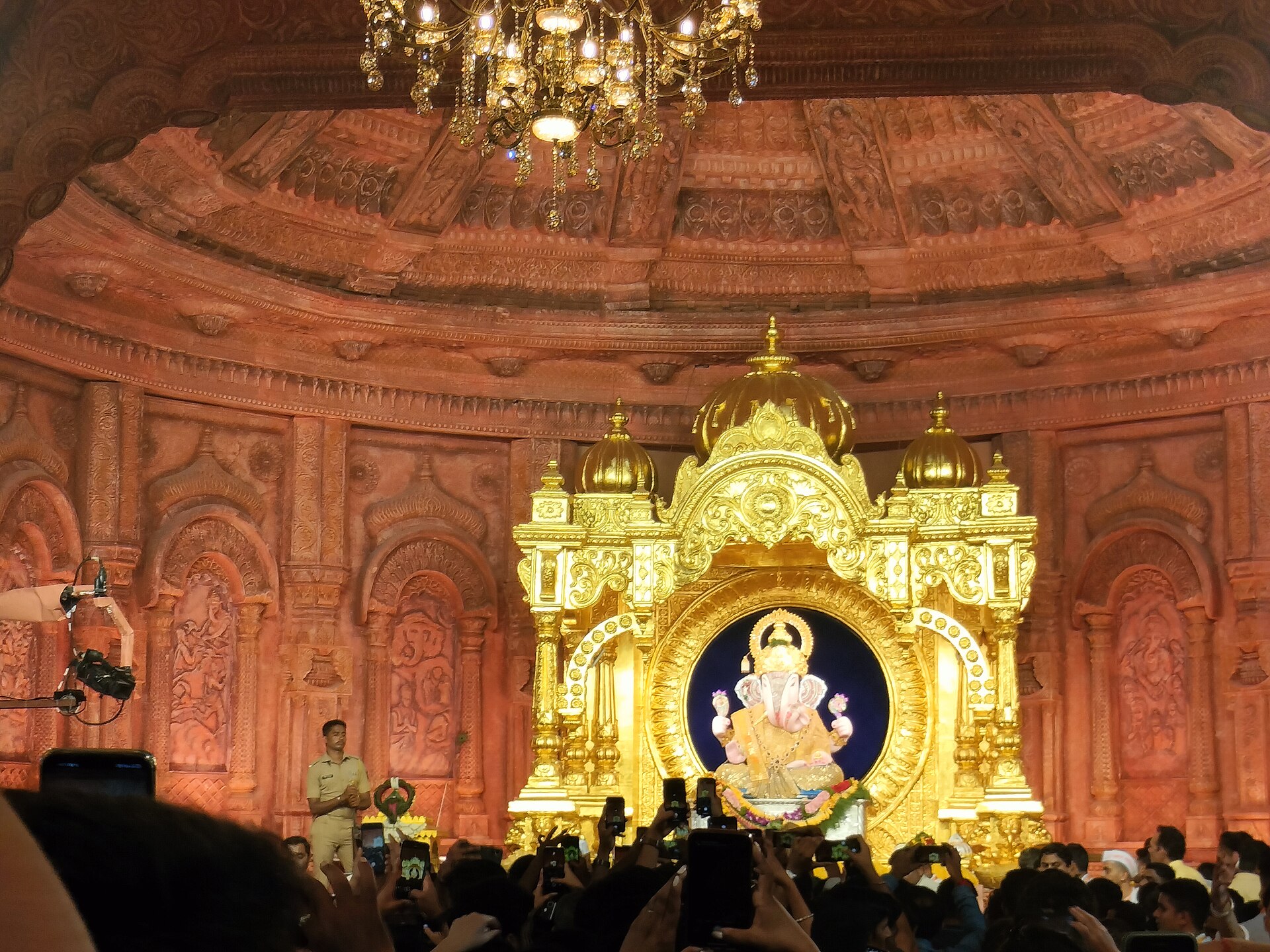
Shrimant Dagdusheth Halwai Ganpati is the icon here, and its origin story is a sad one. In 1893 Dagdusheth Halwai, a wealthy sweet merchant, lost his only son in the plague that swept the Deccan. On his guru’s advice he channelled the grief into installing a Ganesh idol as a vow for future generations. The temple runs year-round, not just during the festival, and the idol wears gold ornaments worth several crores.
Pune’s real distinction is the Manache Ganpati, the five idols that hold ceremonial precedence and lead the immersion procession in a fixed order that has not changed in over a century. Kasba Ganpati goes first, as the gramdaivat or presiding deity of the city, followed by Tambdi Jogeshwari, Guruji Talim, Tulshibaug and Kesariwada. Kesariwada is the one Tilak himself started. If you want to understand the festival’s history rather than just photograph it, walking these five in order is the single best thing you can do in Pune.
The immersion procession here runs for well over 24 hours continuously, with dhol-tasha pathaks, drum troupes that rehearse for months, playing through the night on Laxmi Road.
3. Konkan Coast and Rural Maharashtra
This is the version of Ganesh Chaturthi almost no tourist sees, and arguably the most interesting. In the Konkan villages of Ratnagiri and Sindhudurg districts, Ganesh Chaturthi is the biggest homecoming of the year, bigger than Diwali. Mumbai and Pune empty out as people travel back to their ancestral villages, and the Mumbai-Goa highway and Konkan Railway are booked solid weeks ahead.
The celebration here is home-based rather than pandal-based. Families install an idol in the house, often one made by the same local artisan family for generations, and neighbours move between houses for aarti. Many households keep the idol for only a day and a half or five days rather than the full ten. If you have any connection to a Konkan family, this invitation is worth accepting over any city pandal.
Nagpur and Nashik also hold substantial public celebrations, and Nashik’s immersion at the Godavari ghats is worth seeing if you are in the area.
Also Read: Divine Trip to Trimbakeshwar, History and Travel Guide
4. Hyderabad, Telangana
Hyderabad has quietly built the largest Ganesh Chaturthi celebration outside Maharashtra, and in one respect it beats Mumbai outright: sheer size of idol.
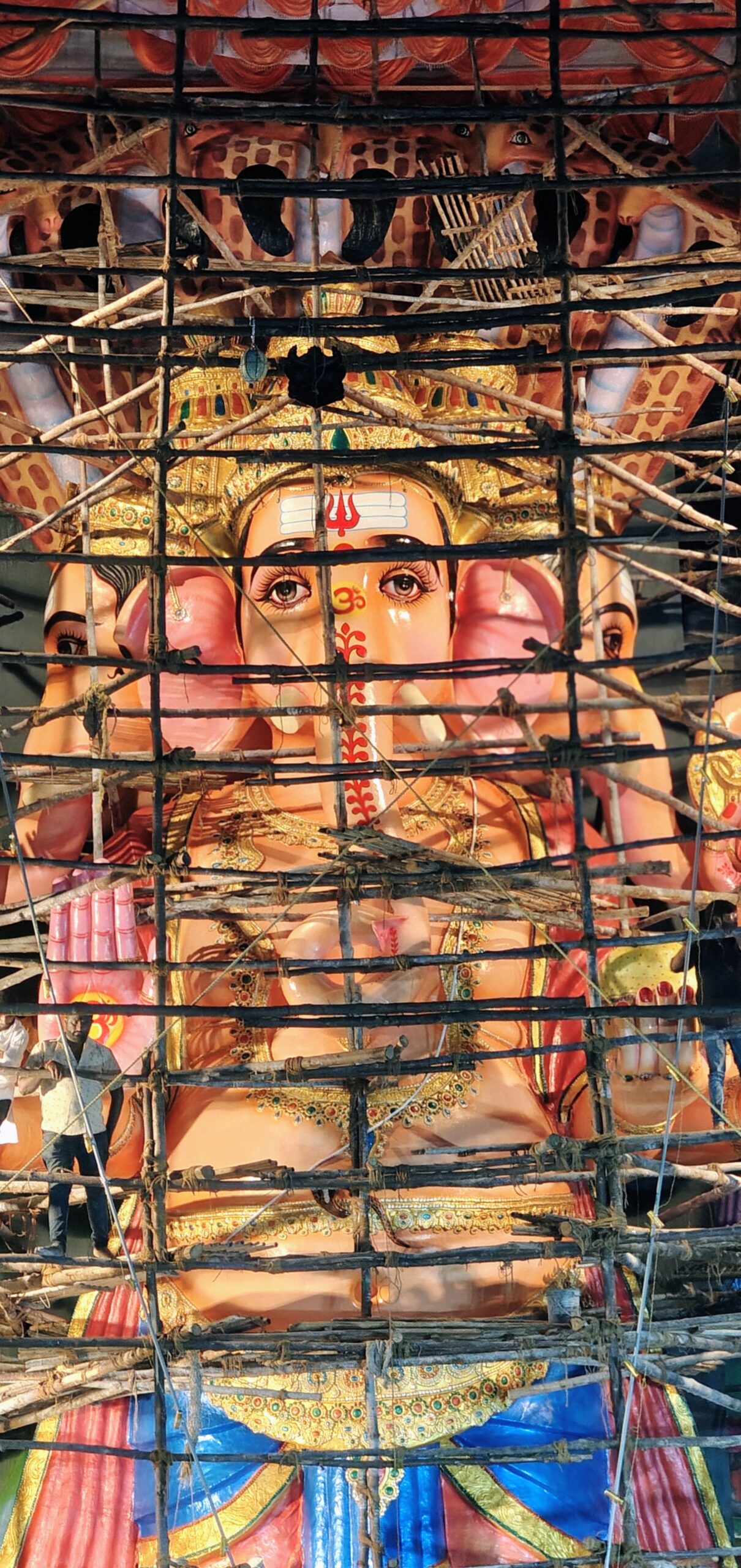
Khairatabad Ganesh is the tallest in the country, and the mandal raises the height most years. The 2025 idol stood 69 feet tall and 28 feet wide, built by over 200 artisans from Chennai, Odisha and Andhra Pradesh, and recent editions have been made from eco-friendly clay and natural colours rather than plaster of Paris. Each year carries a theme, and the scaffolding-and-crane operation to move it is an event in itself.
The festival here is called Vinayaka Chavithi. The immersion procession travels to Hussain Sagar lake, and on the final day the roads around Tank Bund are closed for a procession that runs from morning until deep into the night. Over two lakh idols are immersed across the city’s lakes in a single season. Balapur, on the city’s outskirts, adds a famous twist: the mandal auctions the laddu offered to its idol, and the winning bid regularly crosses tens of lakhs of rupees, with the money going to village development.
5. Goa
Goa’s version, called Chovoth, is the quietest on this list and the one I would recommend to anyone who finds the Mumbai crowds unbearable. There are almost no giant public pandals. The festival happens inside homes, and the state genuinely shuts down for it, more so than for Christmas or Carnival.
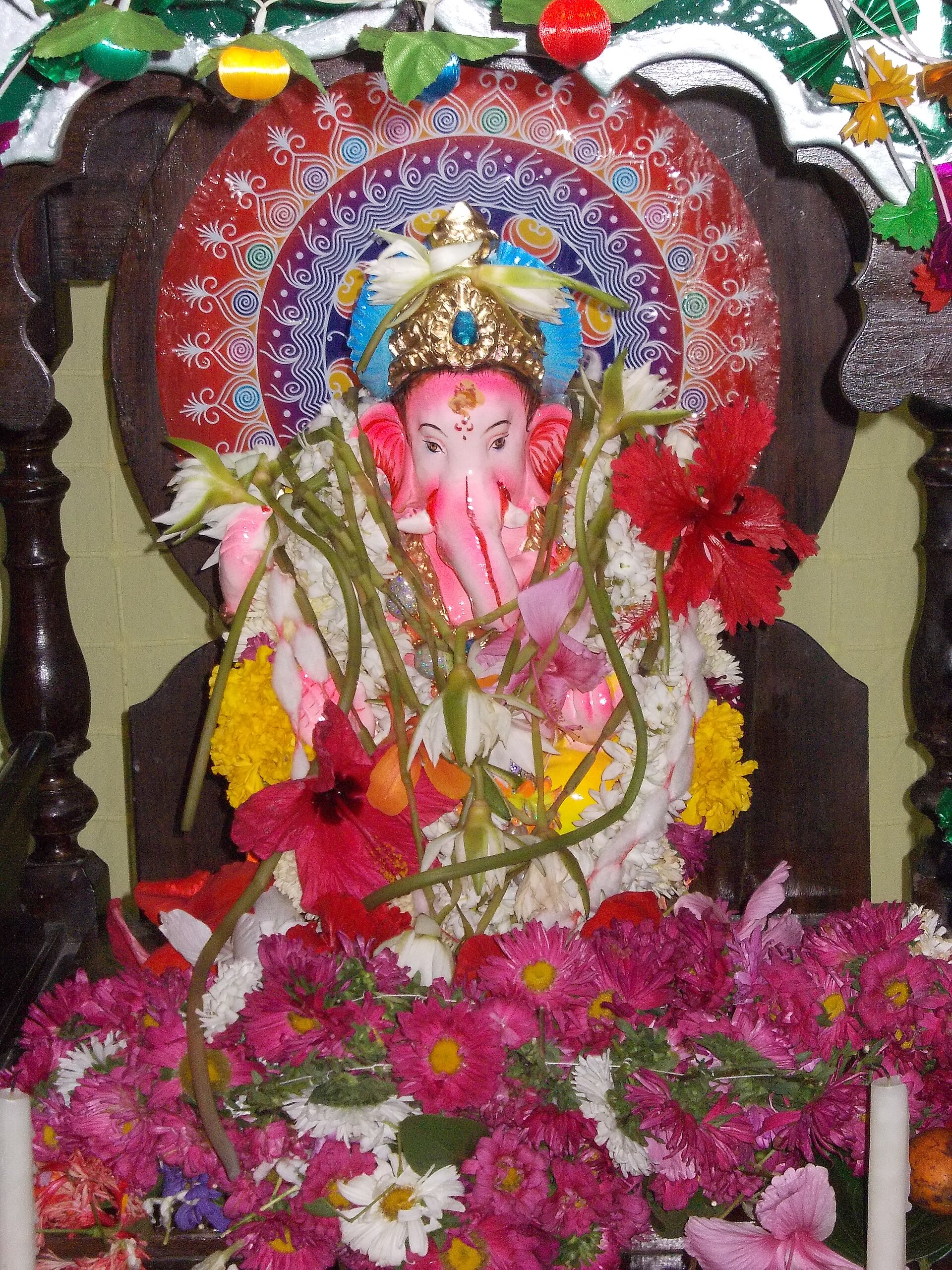
The defining feature is the matoli, a wooden canopy suspended above the idol and hung with seasonal produce: fruits, vegetables, wild forest berries, herbs, coconuts, whole bunches of bananas. Every family’s matoli is different, and the items are either foraged locally or bought at special matoli markets that appear in Margao and Banastarim in the days before. It is essentially a harvest offering, and it makes the Goan celebration a nature festival as much as a religious one.

On the second day comes Nave, the offering of the season’s first paddy harvest to Ganesha. Homes are decorated with flower rangoli, and families sing aartis together in the evening. Most Goan households keep the idol for one and a half, five or seven days rather than ten.
A practical note for travellers: because this is a home festival, you will not experience much of it as an outsider unless you are invited into a house. Many Goan homestays and heritage guesthouses do host guests for aarti during Chovoth, so it is worth asking your accommodation directly.
Also Read: Goa, An Indian State That Redefined Tourism
6. Bengaluru and Coastal Karnataka
In Karnataka the festival is called Gauri-Ganesha Habba, and the naming tells you what makes it different. The day before Ganesh Chaturthi is Swarna Gauri Vrata, dedicated to Gauri, Ganesha’s mother. Married women observe it, and in many families the Gauri idol is installed first and Ganesha arrives the next day to take his mother home. Effectively it is a two-part festival, which you will not find in Maharashtra.
Bengaluru has large public pandals, particularly in the older areas around Basavanagudi and Malleswaram, and the city’s Ganesha idol markets are worth a visit on their own. Coastal Karnataka around Mangaluru and Udupi celebrates with more temple involvement, and the Gokarna and Udupi temple towns are especially active during the period.
Also Read: Ultimate Udupi Itinerary, Beaches, Temples and Heritage
7. Andhra Pradesh
Andhra celebrates Vinayaka Chavithi with a strong community-pandal culture in Visakhapatnam, Vijayawada and Guntur, though at a smaller scale than neighbouring Telangana. The distinctive local element is the puja itself: the ritual uses 21 varieties of leaves, called patri, gathered specifically for the occasion, and reading the Vinayaka Vratha Katha aloud is considered essential. Undrallu, steamed rice dumplings, is the offering here rather than the Maharashtrian modak.
8. Tamil Nadu
Here it is Vinayagar Chaturthi, and the character changes noticeably. It is largely a one-day festival rather than ten, and it is centred on temples and homes rather than street pandals. Chennai does have public installations and a large immersion at the Marina, but the everyday version is a clay idol at home, worshipped for a day and immersed the same evening or the next.
The food marker is kozhukattai, a steamed rice dumpling stuffed with jaggery and coconut, which is the Tamil cousin of the modak. Pillayarpatti Karpaga Vinayagar Temple near Karaikudi, a rock-cut temple with an idol carved into the stone itself, sees particularly heavy crowds during the festival.
9. Kerala
Kerala is the smallest celebration of the major southern states, known locally as Lamboodhara Piranalu and falling in the Malayalam month of Chingam. There is no pandal culture at all. Worship happens at temples, with coconuts and coconut-based sweets as the standard offering.
The one genuinely notable event is in Thiruvananthapuram, where a procession leaves the Pazhavangadi Ganapathy Temple and walks to Shankumugham Beach for immersion, carrying large Ganesha figures built entirely from organic material. Kerala’s festival calendar is dominated by Onam, which usually falls close by, so Ganesh Chaturthi stays modest by comparison.
Also Read: You Can’t Ignore These 5 Places to Visit In Kerala
10. Gujarat, Madhya Pradesh, Chhattisgarh and the North
Across Gujarat, particularly in Surat, Vadodara and Ahmedabad, the festival has grown considerably in recent decades, largely driven by Maharashtrian communities and now adopted widely. Surat in particular has a visible pandal culture.
In Madhya Pradesh and Chhattisgarh the celebration is moderate and home-centred, though individual temples draw crowds. In the north, across Delhi, Uttar Pradesh and Rajasthan, Ganesh Chaturthi is observed but stays a comparatively minor festival, usually a home puja rather than a public event, in regions where Navratri, Dussehra and Diwali dominate the calendar.
Also Read: The Wish Fulfilling Ganesh Temple in Sehore
What to Eat During Ganesh Chaturthi

The modak is inseparable from the festival. It is a steamed dumpling of rice flour filled with jaggery and fresh coconut, and traditionally 21 are offered to the idol. The steamed version, ukadiche modak, is the Maharashtrian standard and is best eaten hot with ghee. Fried modak keeps longer and travels better.
Regional variations are worth seeking out. Tamil Nadu has kozhukattai, Andhra has undrallu, Karnataka makes kadubu, and Goan homes prepare nevri along with the modak. In Maharashtra you will also come across puran poli and shrikhand as part of the festival meal.
Also Read: Must Try Konkani Cuisines From India
Visarjan: How the Festival Ends
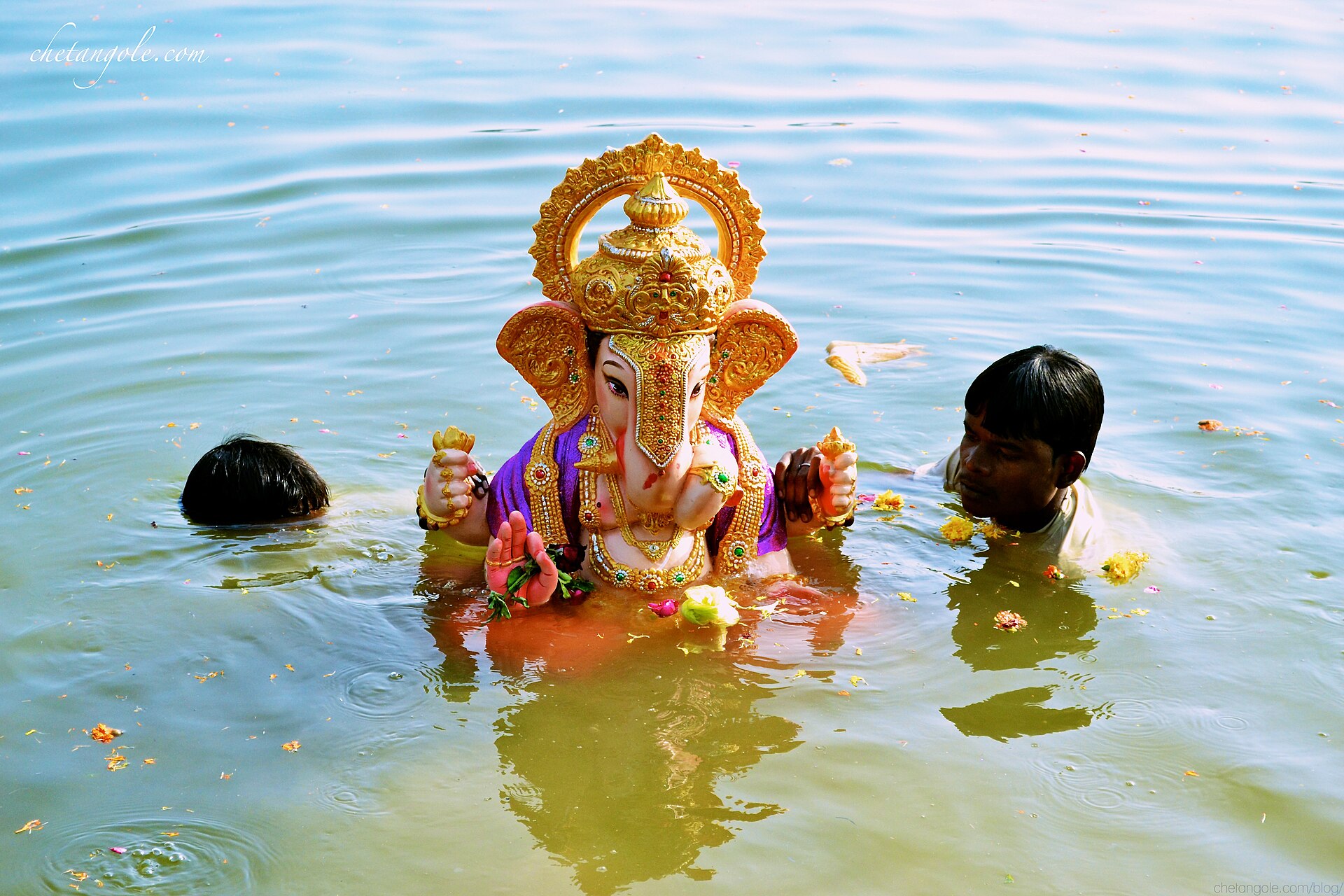
The immersion is the emotional centre of the whole thing. Depending on family tradition the idol is kept for one and a half, three, five, seven or ten days, and then carried to water and immersed while the crowd chants Ganpati Bappa Morya, Pudhchya Varshi Lavkar Ya, roughly “Lord Ganesha, come again soon next year.” The point of the festival is that the deity is a guest who arrives, stays, and leaves.
The environmental side has changed the festival considerably in the last decade. Plaster of Paris idols and chemical paints damaged lakes and rivers badly, and there is now a genuine shift toward clay idols, natural colours, and artificial immersion tanks provided by municipal corporations. Several cities have restricted PoP idols outright. If you are buying an idol yourself, ask specifically for shadu mati, natural clay, and immerse it in a designated tank or even a bucket at home.
Planning Your Trip Around Ganesh Chaturthi 2026
Dates: Ganesh Chaturthi 2026 begins on 14 September 2026 and ends with Anant Chaturdashi visarjan on 25 September 2026. For official state event listings closer to the dates, check the Government of India Utsav portal and Maharashtra Tourism.
Book early. Trains to Maharashtra and the Konkan region are usually full six to eight weeks in advance, and hotels in Mumbai and Pune raise rates for the period. If you plan to be in Mumbai for the final day, book accommodation within walking distance of where you want to be, because getting across the city on Anant Chaturdashi is slow to impossible.
Pick your version. For maximum scale and energy, Mumbai. For history and tradition with a manageable crowd, Pune. For the biggest idol, Hyderabad. For quiet, home-based and genuinely beautiful, Goa. These are very different holidays.
Practical notes. Carry water and expect long stretches on your feet. Many pandals restrict bags and cameras. Photograph respectfully and ask before pointing a lens at families during aarti. Roads close without much notice on procession days, so use suburban trains and the metro in Mumbai rather than taxis. Pickpocketing is common in dense crowds, so keep your phone deep in a front pocket.
One Festival, Many Indias
The thing that stays with you about Ganesh Chaturthi is not the size of the idols. It is that a festival built around a guest arriving and leaving can mean overnight queues and thundering drums in one city and a canopy of fruit hung quietly above a family shrine in another, and both feel completely right. If you have only ever seen the Mumbai version on television, the Goan or Konkan version will surprise you more.
Also Read: 14 Most Famous Religious Festivals of India