

The Phuket Vegetarian Festival is the most graphic religious event I know of in Asia, and the gentle word “vegetarian” in its name hides that completely. For nine mornings, men and women in a trance walk through Phuket Town with swords, skewers and stranger objects pushed through their cheeks, and photos do not prepare you for how close it all happens.
The rest of it is very different: streets full of people in white, shrines thick with incense, firecrackers by the sackful, and the best meat free street food in Thailand. In 2026 it runs from Saturday 10 October to Sunday 18 October, with the opening pole raising on the evening of Friday 9 October.
The Piercing Warning, Plainly
The spirit mediums are called mah song, which means horses of the gods. Devotees believe a deity rides the medium, shields the body from pain and takes the community’s bad luck onto itself. The piercing is done in the shrine yard before dawn. Then the mah song walk the whole route, each with a small team wiping the wound and supporting the weight of whatever has gone through the cheek.
There is blood. Some mediums also cut their tongues or whip their own backs. If you have stood near kavadi bearers at Thaipusam, in Palani or at the Batu Caves in Malaysia, you have a reference point, but Phuket goes several steps further. I would not take children under twelve to a morning procession, and I would not take anyone who goes pale at a blood test.
Luckily, the graphic part of the Phuket Vegetarian Festival is easy to avoid, because it is limited to the morning street processions and the shrine yards just before them. Visit the shrines in the afternoon, when they are calm and smell of sandalwood. Watch the fire walking and the last night send off, which are about fire and noise, not blades.
How a Sick Opera Troupe Started It
Phuket’s wealth in the 1800s came from tin, and the miners were mostly Hokkien Chinese settled around Kathu, in the hills between Phuket Town and Patong. The shrines tell the origin of the Phuket Vegetarian Festival the same way: around 1825 a travelling Chinese opera troupe came to entertain the miners and fell badly ill with a fever that was going around the camps.
The performers decided they had neglected the Nine Emperor Gods, the star deities honoured back home in the first nine days of the ninth lunar month. They gave up meat and alcohol, prayed for nine days, and recovered. The miners copied them. Later, the story goes, a local man sailed to Jiangxi in China and returned with sacred incense and scriptures, and the crowd that walked to the pier to receive him became the first street procession.
Two centuries on, the same rite is kept in Krabi, Trang, Bangkok’s Chinatown and across Malaysia and Singapore, but nowhere with Phuket’s intensity. For Indians there is a nice coincidence too. The nine days almost exactly overlap with our own Navratri, which begins on 11 October in 2026, and several of the fasting rules are ones your grandmother would recognise.
Phuket Vegetarian Festival 2026 Dates, Shrine by Shrine
Around 40 Chinese shrines take part in the Phuket Vegetarian Festival, but the big street processions belong to a handful of them, one shrine per morning. The order follows the lunar day and has stayed much the same from year to year, but not every shrine had published its 2026 timetable when I wrote this. Treat the sequence below as a guide and the start times as approximate. Each shrine pins its final timings on a board outside, so confirm the evening before.
| Date | Shrine | What happens |
|---|---|---|
| Fri 9 Oct, evening | All shrines | Go Teng pole raised, nine lanterns lit |
| Sat 10 Oct | All shrines | Fast begins, food stalls open |
| Sun 11 Oct | Naka | Procession, about 7.30 am |
| Mon 12 Oct | Sapam | Procession, about 7 am |
| Tue 13 Oct | Sam Kong | Procession, about 7.45 am |
| Wed 14 Oct | Ban Tha Rue | Procession, about 6 am |
| Thu 15 Oct | Bang Neow | Procession, about 6 am |
| Fri 16 Oct | Jui Tui | Procession, about 7 am |
| Sat 17 Oct | Kathu | Procession, about 6.45 am |
| Sun 18 Oct | Sui Boon Tong, then all shrines | Last procession, bridge crossing, night farewell at Saphan Hin |
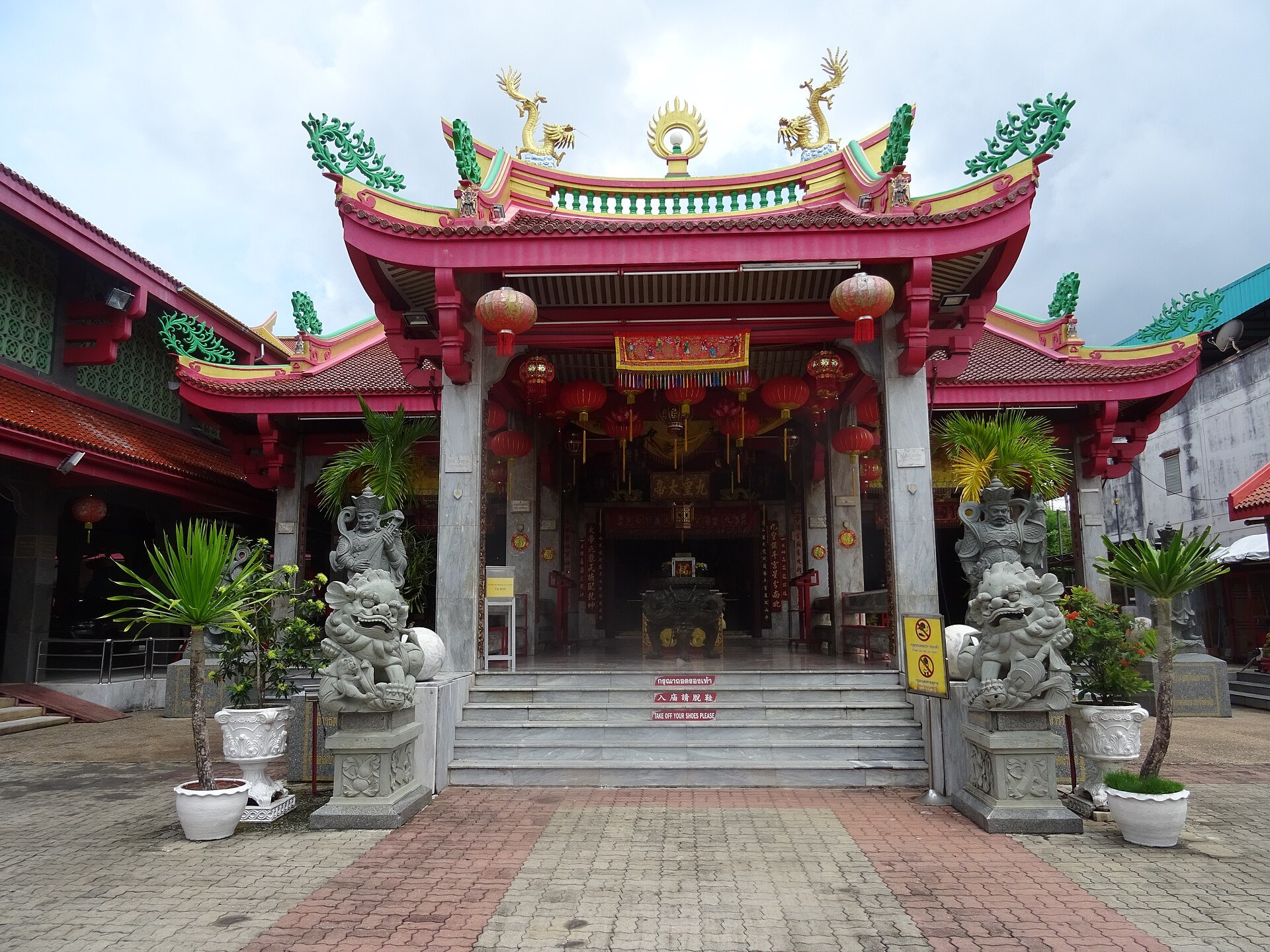
Jui Tui and the Food Street
Jui Tui, just off Ranong Road, is the busiest shrine and the one I would use as a base. Its Friday procession is one of the two largest of the week, the road outside becomes the main food street, and most Old Town hotels are a ten minute walk away.
Bang Neow
Bang Neow sits on Phuket Road at the southern end of town, on the way to Saphan Hin. Its Thursday procession is as big as Jui Tui’s and has a reputation for the most extreme piercings. Skip this morning if you are nervous.
Kathu, Where It Began
Kathu Shrine is about 9 km from the Old Town, in the old mining village. It is smaller and feels like a neighbourhood affair. On Saturday its mah song walk barefoot all the way into Phuket Town and down to the sea, the longest route of the week. Come on a different afternoon to see the birthplace of the Phuket Vegetarian Festival without the crush.
Sui Boon Tong and the Outer Shrines
Sui Boon Tong, also in town, takes the final morning. Sapam and Ban Tha Rue lie north of the city on the airport road, Sam Kong is on the northern edge of town, and Naka stands near the weekend market. Their processions are shorter and far less crowded.
A Procession Morning on the Street
A Phuket Vegetarian Festival procession starts early, so be on the pavement by 6.30 am. Yaowarat Road, Thalang Road and the Surin Circle clock tower are the classic spots, and shopkeepers along the route set up small altars with tea, fruit and candles. First come banners and drummers, then boys carrying small palanquins, then the mah song in embroidered aprons, stopping at each altar to bless the family.
Then the firecrackers start. Locals throw whole strings at the feet of the palanquin bearers, who run through them shirtless with towels wrapped around their heads. The noise is physical. Carry foam ear plugs, a mask for the smoke and a pair of glasses, wear closed shoes, and choose cotton you do not mind getting small burn holes in.
Wear white. It is not compulsory for onlookers but nearly everyone does it, and a plain white T-shirt costs 100 to 150 baht (roughly Rs 300 to 450) near the shrines. Never step into the path of a mah song for a photo, never touch one, and move aside if one walks towards you. Keep meat and alcohol well away from the shrines. Pick a first floor cafe window if you want distance.
Local custom asks women who are pregnant or menstruating, and anyone in mourning, to stay out of the shrine rituals. Nobody checks, but respect it.
After Dark: Fire, Blades and a Bridge
The evenings of the Phuket Vegetarian Festival are when I would bring a nervous friend. On several nights in the second half of the week, the larger shrines lay out a bed of glowing charcoal and the mah song walk or run across it. It usually begins around 8 pm, so arrive an hour early.
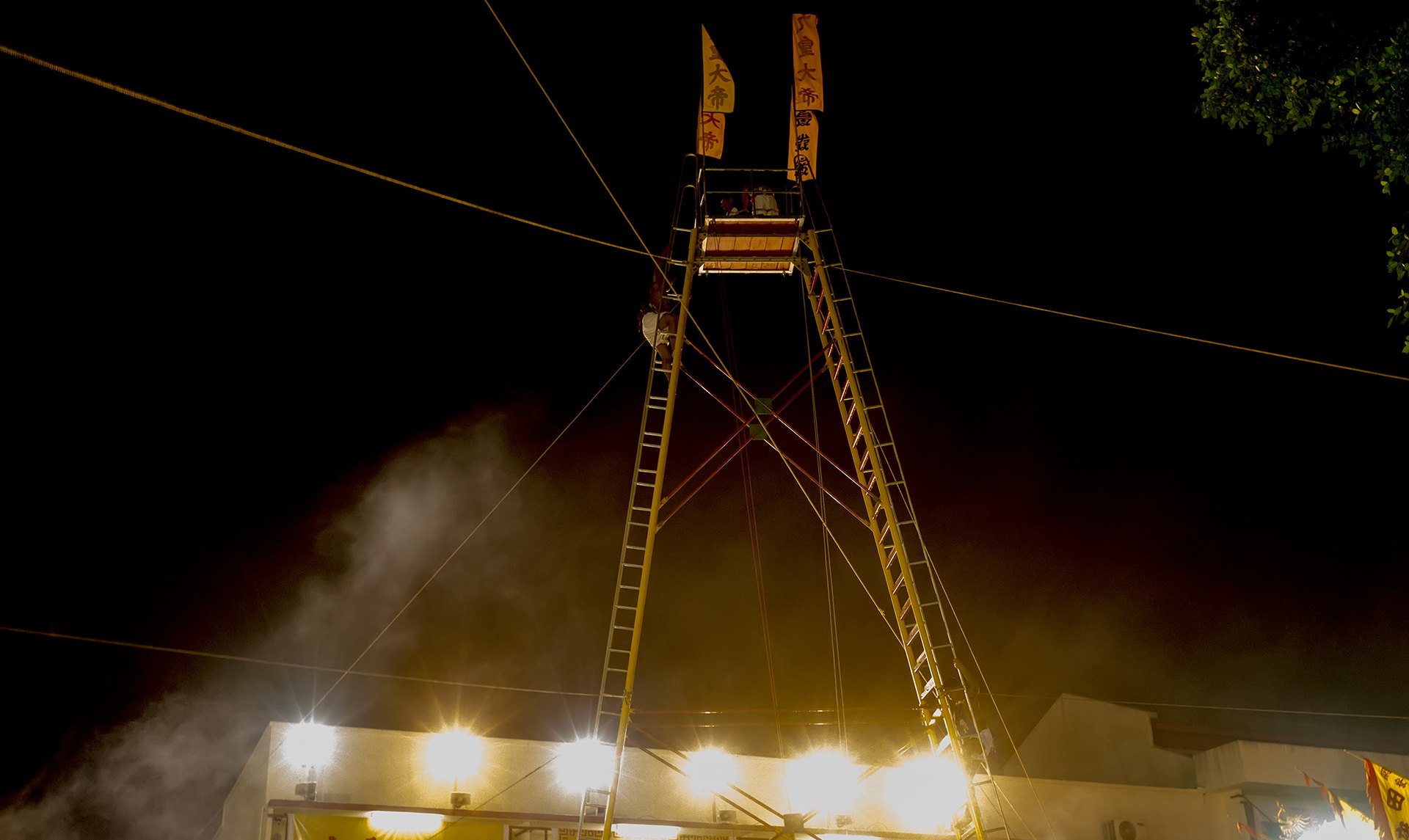
The bladed ladder is stranger. A tower of two ladders goes up, every rung a sharpened blade facing upward, and mediums climb one side and come down the other barefoot. Sam Kong and Bang Neow are the shrines known for it. On the last day comes the bridge crossing, where devotees walk over a small bridge and get a red seal stamped on the back of the shirt, the year’s bad luck left behind. Visitors may cross too.
The Last Night at Saphan Hin
On Sunday 18 October, from about 9 pm until well after midnight, every shrine carries its gods through town to Saphan Hin, the seafront park at the southern tip of Phuket Town, to send them home by water. This is the loudest night of the Phuket Vegetarian Festival. Phuket Road turns into a tunnel of firecracker smoke, and you will see far fewer piercings than in the mornings.
If you have only one night, make it this one, with two honest cautions. Debris flies everywhere, so long sleeves, ear plugs and glasses are a must. And the crowd is dense enough that I would keep children on a balcony. After midnight the lantern poles come down and the fast is over.

Yellow Flags and Jay Food
Every stall and restaurant keeping the fast hangs a yellow flag with a red Thai word on it that looks a lot like the number 17. It reads “jay”, from the Chinese word zhai, and it is the only signboard a vegetarian needs in Thailand in October. In Phuket the centre of it is Ranong Road outside Jui Tui, lined with stalls from mid afternoon until about 10 pm.
Jay food is stricter than vegetarian. It has no meat, fish, eggs or dairy, no fish sauce or oyster sauce, and none of the pungent vegetables: garlic, onion, spring onion and chives. That last rule is why the Phuket Vegetarian Festival suits Indian vegetarians, and families who cook without onion and garlic, better than any other week in Thailand. Jain travellers should still ask, because potato, taro, carrot, radish and mushrooms are used freely.
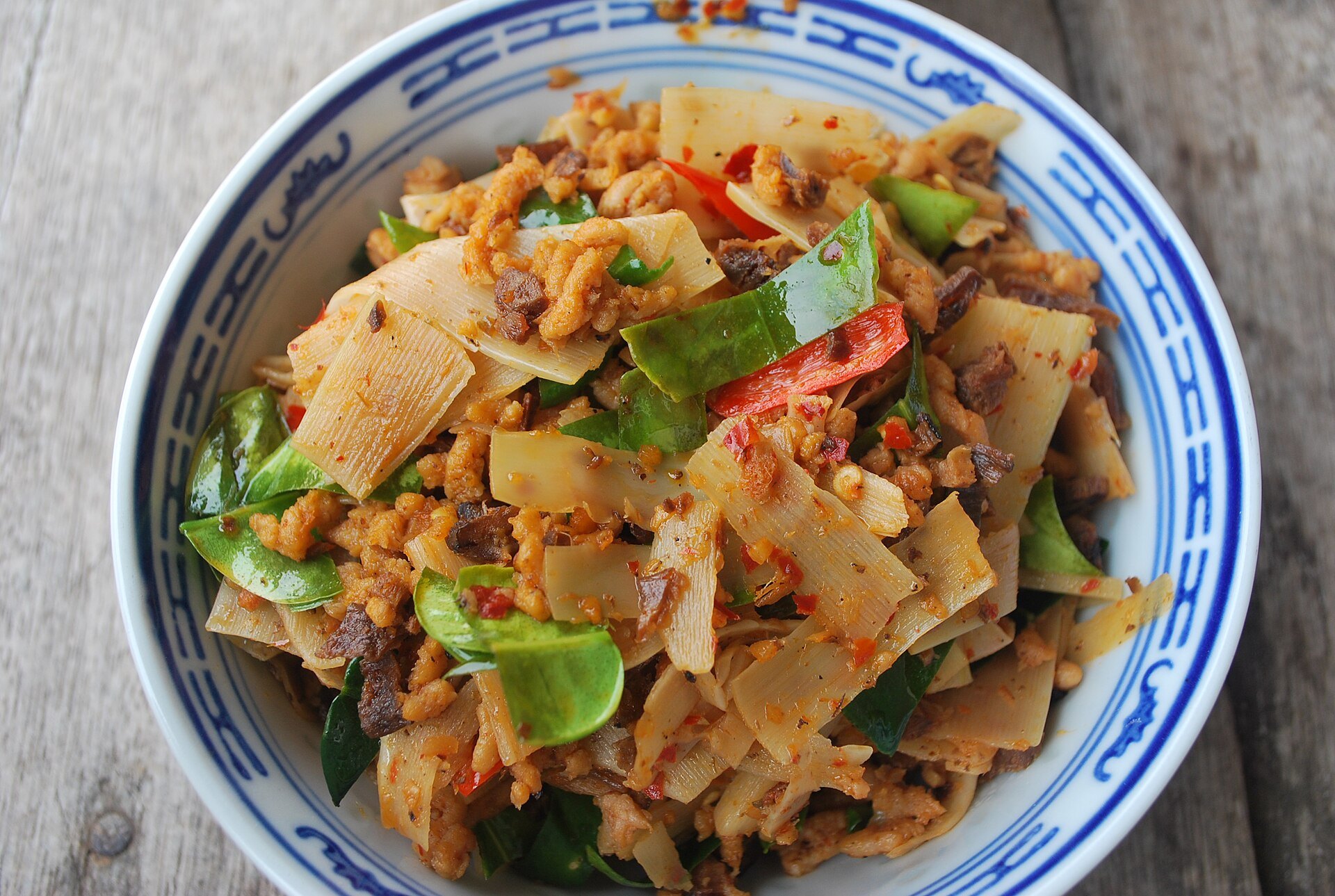
What to eat: yellow Hokkien noodles fried with greens and tofu, fried taro and spring rolls, tofu satay with peanut sauce, sweet potato fritters, stir fried bamboo shoots, and warm soy milk with fried dough sticks. At the Phuket Vegetarian Festival most plates cost 30 to 80 baht, and rice with three toppings at a jay buffet is 80 to 120 baht. A baht is a little under Rs 3 right now, so think Rs 90 to 350 a dish.
My complaint is the oil. A lot of jay street food is deep fried, and the mock meat can be so convincing that it puts some vegetarians off. Look for stalls making noodle soups and stir fries to order. Remember too that jay cooking has no paneer, curd or milk tea, and that nobody drinks alcohol anywhere near the shrines.
Visa, Flights and Where to Sleep: Notes for Indian Travellers
Visa and the Arrival Card
Indian passport holders do not need a visa for a short holiday in Thailand, but the permitted stay has changed. From 15 September 2026 the visa free period is 30 days, cut from the 60 days allowed since 2024, and it covers tourism only. The rules have moved three times in three years, so check the Royal Thai Embassy in New Delhi website in the week before you fly.
You must also fill the Thailand Digital Arrival Card online within three days before landing. It is free on the official TDAC site, so ignore agents who charge for it. Carry a passport with six months of validity, a return ticket, your hotel booking, and funds of 10,000 baht per person or 20,000 per family, which officers check only now and then.
Flights to Phuket
Phuket has its own international airport, so there is no need to route through Bangkok or Pattaya unless you want them on the same trip. As of this October, IndiGo flies nonstop from Delhi, Mumbai, Bengaluru and Kolkata, Air India from Delhi, and Air India Express from Bengaluru. Flying time is about 3 hours from Kolkata and 5 from Delhi. October is low season, so return fares of Rs 16,000 to 28,000 are common.
The airport is 32 km north of the Old Town. A taxi costs 650 to 800 baht. The orange airport bus to the town bus terminal is 100 baht and takes about 80 minutes.
Old Town or the Beaches
For the Phuket Vegetarian Festival, stay in Phuket Old Town. The processions pass your door, the food street is a walk away, and you avoid a 5 am taxi from the coast on mornings when half the roads are closed. Guesthouses in old Sino-Portuguese shophouses around Thalang and Dibuk roads run from about 900 to 2,500 baht a night (Rs 2,600 to 7,300), more in festival week.
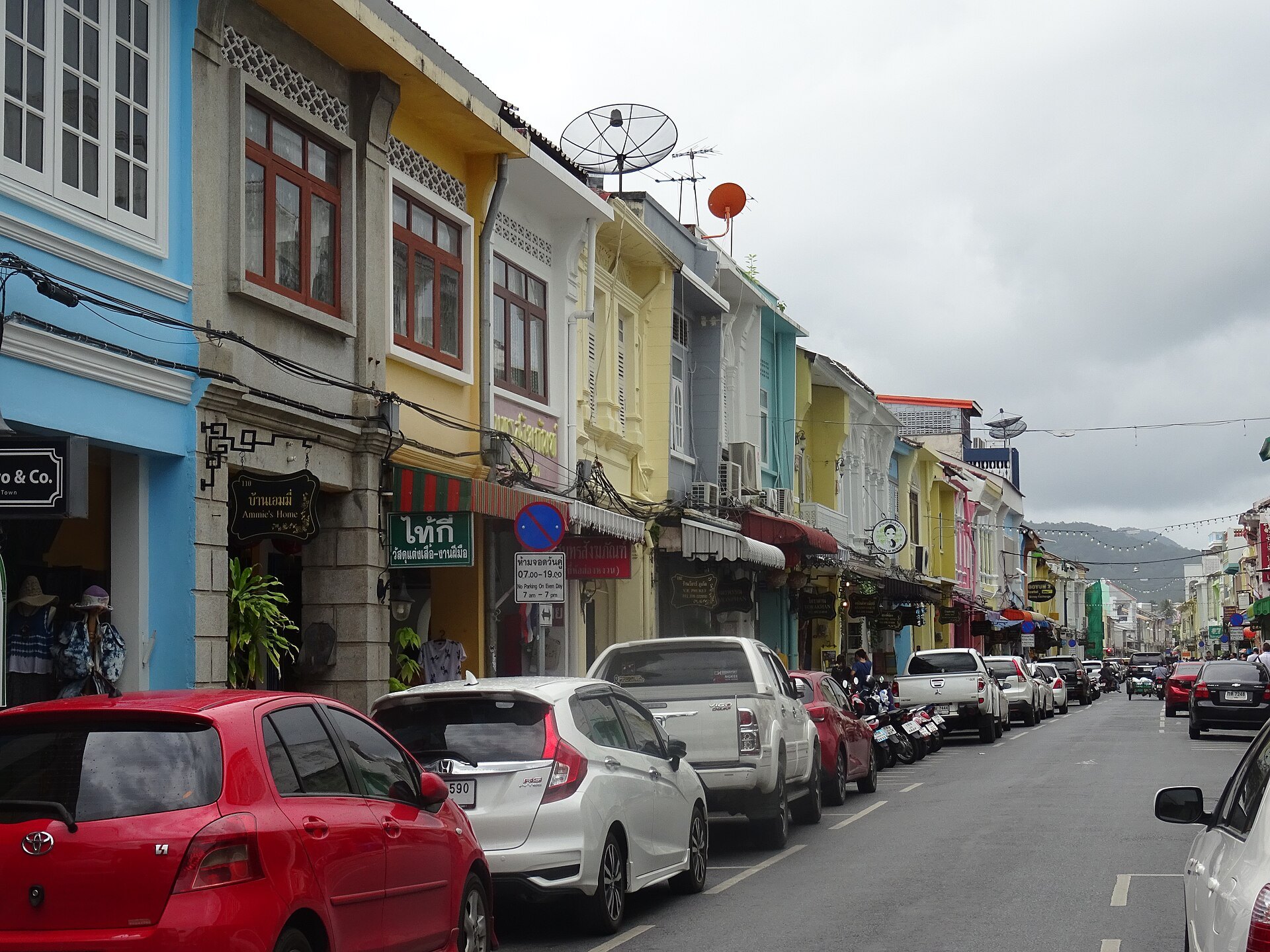
Patong, Karon and Kata are 15 to 20 km away, about 40 minutes on a clear road. They make sense if the festival is one morning of a beach holiday, and my Phuket trip guide covers them. October is the tail of the monsoon. Expect a heavy shower most days, around 300 mm of rain over the month, 24 to 31 degrees, and red flags on the west coast beaches. Processions go ahead in the rain.
What a Day Costs
Leaving out flights, a couple sharing a mid range Old Town room can manage on Rs 4,000 to 6,000 per person per day. That is about Rs 2,200 for your half of the room, Rs 900 to 1,200 for jay meals, and the rest on Grab rides and a shrine donation. The Phuket Vegetarian Festival itself is free. Krabi and Koh Lanta are half a day away by road and ferry if you want islands afterwards.
Also Read: 10 Most Beautiful Places to Visit in Thailand
Should You Go?
Yes, if living faith interests you and you can handle seeing things you cannot unsee. No, if you want a lazy beach week, or if you cannot keep small children away from the morning routes. For Indian vegetarians who have always found Thailand hard to eat in, the Phuket Vegetarian Festival is the one week when a whole island cooks for you. I would go for the last four days, sleep in the Old Town, and watch the piercing once, from a distance.